After tile grout sealing construction, many homeowners encounter embarrassing issues: small bubbles on the surface of the grout, local hollows and hollows, softness when pressed, and easy cracking and falling off in the later stage. These not only affect aesthetics but also easily harbor dirt and mold. The bubbling and hollows in the grout are not solely a material issue; most often, flaws arise in the four major aspects: base layer, environment, construction, and materials. Below, we will analyze the specific reasons in detail and provide prevention and solutions.
1. The issue of gaps at the base layer is a common cause of blistering and hollow spots
1. The interior of the brick joints is damp and not fully dried
After tiling, the cement mortar has a high water content. If the curing time is insufficient and there is residual water and moisture in the gaps, directly applying grout will seal the moisture inside. When the temperature rises later, the water vapor expands due to heat, which will lift the surface of the grout, forming bubbles, bulges, and hollows.
2. The joint cleaning is not thorough, leaving residual debris and gaps
Before construction, residual cement dust, sand particles, debris, and hollow mortar in the gaps were not cleaned up and vacuumed. After the sealant was applied, the debris supported the formation of voids, and after curing, the interior was not solid, resulting in hollows. The dust hidden in the gaps was subject to moisture and fermentation, producing gas, which also pushed up the surface layer, causing bubbles.
3. The tile itself has uneven gaps and hollows at the bottom
When laying tiles, there are inherently hollow areas at the bottom of the tile joints due to an unsubstantial cushion. After filling with grout, the joints cannot adhere to the substrate, naturally resulting in overall hollow areas. If the joints are too wide or of varying depths, the grout is prone to breaking during application, leaving air inside and causing bubbles to form later on.
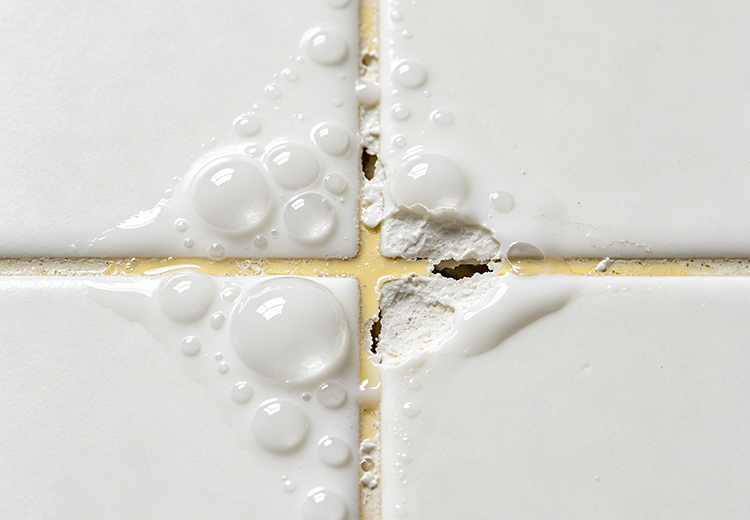
II. Non-standard construction operations, resulting in blistering and hollow areas caused by human factors
1. The glue is not applied fully and air is mixed in
If the construction team applies sealant too quickly and the sealant is dispensed intermittently, the sealant may not fill the gaps densely and may contain a large amount of air trapped in between. If the air cannot be released after the sealant cures, it will form numerous small bubbles and localized hollow areas.
2. Uneven mixing of double-tube beauty sealant
If the two-component grout is not fully shaken and mixed evenly, or if the mixing ratio is imbalanced, the curing reaction may be inconsistent, resulting in slow curing in some areas and chemical reaction gases generated inside that accumulate beneath the surface, causing bumps and bubbles. Incomplete curing can also lead to poor bonding strength, resulting in the entire sheet becoming hollow and falling off.
3. Errors in the timing and technique of seam pressing
If the joint is pressed too early, the adhesive is still flowing, which is prone to air entrainment and uneven surface tension; if pressed too late, the adhesive is partially cured and is forcibly pressed, damaging the internal structure and causing delamination and hollowing; uneven pressing force can also lead to local cavity blistering.
4. The construction base surface has oil stains and wax layers
The tile surface contains release wax, cleaning wax, oil stains, and glue residue. The grout cannot adhere firmly to the tile wall, but merely floats on the surface. In the later stage, it shrinks and delaminates, forming hollows, edge warping, and bubbles.
III. Environmental temperature and humidity and weather impact
1. Construction under high temperature and intense sunlight
During construction in high-temperature environments during summer, or under direct sunlight on balconies, the grout cures too quickly, causing the surface to instantly form a crust. The gas generated by internal reactions cannot escape and becomes trapped, forming numerous bubbles. Simultaneously, high temperatures accelerate the shrinkage of the adhesive, making it prone to detaching from the tile wall and causing hollowing.
2. Construction under low temperature, high humidity, and rainy weather conditions
During construction in enclosed spaces on days with high humidity, dampness, or rain, a large amount of water vapor in the air gets trapped inside the sealant. During the curing process, the water vapor condenses and produces gas, causing bubbles. Low temperatures can slow down the curing process, reduce the bonding strength, and lead to delamination and hollowing in the later stages.
3. Direct and excessive ventilation
Immediately after construction, windows are opened to let in fresh air, and air conditioning is directed at the grout joints. The surface dries and forms a crust quickly, while the interior continues to react and shrink. If the contraction is not uniform between the interior and exterior, it can lead to bulging, bubbling, and cracking.
4. Quality issues with the beauty sealant product itself
1. The formula of inferior raw materials is unstable
Low-priced, non-branded grout sealants often contain impurities, have non-standard proportions, and insufficient curing agent content. During the curing process, intense chemical reactions occur, generating a large amount of gas and leading to easy bubbling. The colloids exhibit poor flexibility and bonding strength, high shrinkage rates, and are prone to detaching from tile gaps, resulting in hollow areas.
2. Expired products or improper storage
If the beauty sealant is expired, exposed to direct sunlight, or damaged by frost, its internal components may deteriorate, leading to abnormal reactions after mixing. After application, it is prone to bubbling, non-curing, and hollow or delaminated areas.
How to prevent foam and hollowing in the beauty seam in advance?
After laying the tiles, ensure adequate curing and ventilation. Allow them to sit for at least 15-20 days to ensure the tile grout is dry before proceeding with further construction. For wet kitchens and bathrooms, as well as floors with underfloor heating, extend the drying time appropriately.
2. Before construction, thoroughly clean the joints and vacuum the area to remove cement residue, dust, oil stains, and wax layers, ensuring that the joints are dry, clean, and free of voids.
3. Apply the sealant at a steady and full speed, filling the gap completely in one go to avoid air infiltration due to sealant breaks; for double-tube seam sealing, first remove the uneven sealant at the front end, mix it thoroughly, and then proceed with the construction.
4. Avoid construction during high-temperature exposure, rainy days, and humid days; do not open windows to direct drafts or direct air conditioning vents towards the ground within 24 hours after construction.
5. Choose qualified sealant from reputable brands, and avoid using expired or deteriorated products; for areas with floor heating, select specialized sealant materials with good flexibility and low shrinkage rate.
Some content is reposted from the internet. Copyright belongs to the original authors. If infringement occurs, please contact us for removal. Content involving franchising or investment carries risks - exercise caution when making decisions.


